

Why Thermal Management Decisions Need to Start Earlier

In electronics manufacturing, some of the most important thermal management decisions happen long before production begins.
As electronic devices are engineered to be smaller, faster and more powerful, they create more heat in tighter spaces. That heat must be controlled to help protect performance and long-term product life—making thermal management a critical part of discovery, material selection and pre-production.
Why Early Decisions Matter
Thermal management decisions can have a lasting impact on a product’s performance in the field. A material that looks right on paper may not be the best fit once the full application is considered. The interface may be too thin or too thick. The surface may be uneven. The component may be pressure sensitive. The assembly process may require automation. The application may need electrical isolation, reworkability or a specific cure schedule.
Early collaboration matters. When design, manufacturing, sourcing and supplier partners align before production, teams can better evaluate the full application rather than react to issues later. These conversations can help clarify what the thermal interface needs to accomplish, how the material will be applied and what trade-offs should be considered.
Material Selection Starts With the Application
Effective selection of thermal interface materials begins with understanding the application.
Before recommending a material, teams should consider questions such as:
- What is the total heat or power of the component?
- What is the required bond line thickness?
- Does the application need electrical isolation?
- Will the material be applied manually, dispensed, printed or automated?
- Is rework required?
- Are there reliability, environmental or certification requirements?
- Are there storage, packaging or production-volume considerations?
This is where R.S. Hughes’ technical expertise helps electronics engineers and manufacturers move from product category to informed material selection—narrowing options based on design specifications and production requirements.
Strengthening Thermal Expertise With Henkel AMI Training
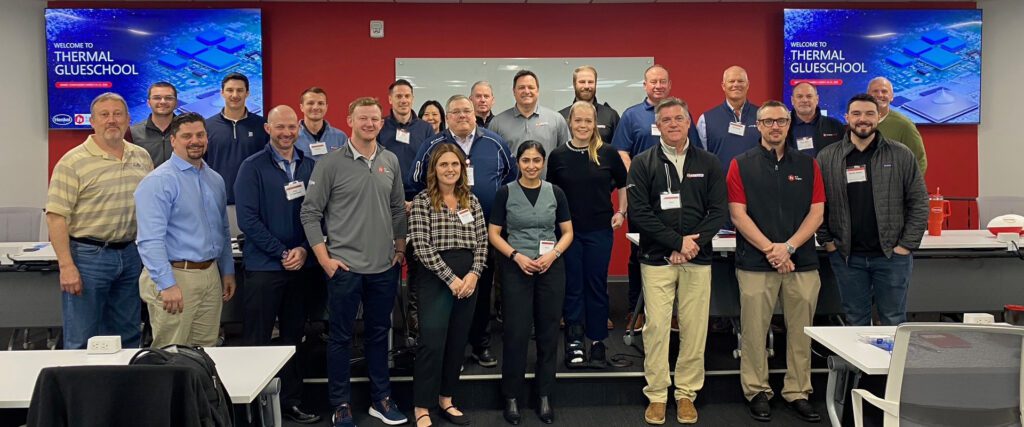
R.S. Hughes recently joined Henkel at their hands-on Thermal Glue School training, focusing on thermal management technologies and application considerations across electronics manufacturing. The training covered the fundamentals of thermal interface materials, gap fillers, thermal gels, gap pads, phase change materials, thermal grease, Sil-Pad products and thermally conductive adhesives.
The value from Henkel’s training goes beyond product knowledge. With a strengthened understanding of how electronics manufacturing materials behave in real-world applications, our team is better equipped to compare options, identify key application variables and facilitate more productive technical conversations earlier in the process.

The Moments That Matter Happen Before Production
The moment that matters most in thermal management isn’t when a product fails in the field. It isn’t when a material must be swapped mid-production. It’s earlier—when a design engineer is still asking questions and the right conversation hasn’t happened yet.
That’s the moment R.S. Hughes is built for.
Electronics engineers and manufacturers need more than reliable distribution. They need a partner who can help identify the right questions before the wrong materials get specified. One with deep technical knowledge, sharp material training and a better understanding of key tradeoffs.
When thermal management decisions start early, and the right expertise is in the room, teams move faster, make more confident material choices and avoid the downstream costs of getting it wrong.
See how R.S. Hughes supports electronics manufacturers from material selection to production.