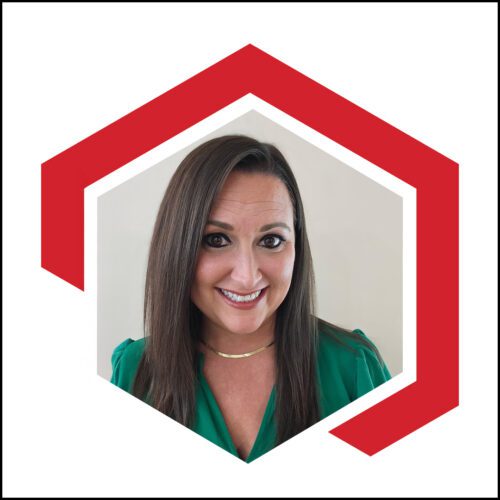

Brandi Lindsey: From Hair to Quality Control

A chance conversation at 17 changed Brandi Lindsey’s career path forever. Read about her journey from aspiring hairstylist to quality leader at R.S. Hughes as we celebrate International Women’s Month.
Contributed by Brandi Lindsey, Quality & Compliance Manager, 4 years
Growing up, my dad worked as a top salesman for Motorola, so instead of a Barbie house, I had a full desk equipped with tape dispenser and stapler. I held some very important meetings with the neighborhood kids during those days and always expected business to be my career path. However, my mom was an award-winning stylist for many years, so I began training at 17, still undecisive about where I would really land.
That all changed one day when I started chatting with a woman at a restaurant. “You’re really smart,” she told me. “I don’t know if being a hairstylist is your career path. I’d like you to work for me doing data entry.”
Her father owned a registrar company that issued ISO 9001, aerospace (AS9100, AS9120, AS9110, etc.) and environmental (ISO 14001) certifications. I took the job and was thrown into the deep end. On my first day, I was literally Googling “What is ISO?” Those first few weeks were a crash course in quality as I tried to fake it till I made it, all while continuing my college classes.
Not long after I started, my learning curve got even more intense. The woman who hired me put a huge stack of folders on my desk and said, “Today’s my last day, so these are all yours; good luck.” Suddenly, I was moved into her office and took over her responsibilities. I went from entering data to making decisions, reviewing and approving audit reports, handling audit scheduling, and auditor qualifications.
That’s how my career in quality and compliance began. Those early lessons and work with the Accreditation Body (ANAB) taught me quickly what “not to do” while also learning what auditors are looking for during an assessment. After ten years at the registrar, I became a lead auditor and learned the certification requirements inside and out.
Bringing the Standards to Life
The standard is very risk-centered. It requires you to consider risk at every stage. At a registrar, risks are limited to registrar-related risks, like failure to get documentation from people and things like that. But I wanted to see the standards in practice, so I joined an aerospace manufacturing company as a quality engineer.
The role had me managing quality for specialized processes around forging metal parts to ensure there were no defects in the materials. I learned how to take precise measurements, read technical drawings and understand acceptance requirements such as pre-production approvals. From a manufacturing perspective, you are looking at the product, how the materials react and the equipment and resources you have available.
Planning for quality is critical in the manufacturing process and something this new role made very clear to me. You do not really understand what quality looks like for a product until you are working with your engineering and production teams, walking through all the steps. Then you begin to realize why the standard puts such a big emphasis on certain aspects. The process involves asking a lot of “what ifs,” so that when you reach that stage in the process, you are prepared for anomalies.
It made the standards come alive. In the registrar world, you understand the requirements on paper. In manufacturing, you see why every step matters. It was a very hands-on role. Some days, I would walk into the office with my face grimy from working around equipment and materials. It was dirty technical work. But it was an incredible learning experience.
Risk analysis was a critical part of my job. Each new product required evaluating potential failure points, understanding their impact and identifying ways to prevent them. In manufacturing, the risks are tied directly to the product and how materials behave, how equipment performs and how each step of production could affect the final result.
My experience as an auditor helped because I already understood the standards and the areas auditors focus on. That background helped me organize documentation and strengthen processes. Working with metals and how heat and cooling affect them is a science. I spent a lot of time in the testing lab and worked closely with engineers. That experience reinforced something I still believe today: in quality and compliance the learning never really stops.
Building and Strengthening Quality at R.S. Hughes
When R.S. Hughes recruited me, I was hesitant at first. I questioned whether I wanted to work in distribution. But the company’s strong aerospace footprint stood out, and I saw an opportunity to broaden my experience in quality.
What ultimately convinced me was the chance to build something and make a positive impact. After speaking with several employees, including our former Director of Quality and Compliance, I realized there was an opportunity to strengthen and expand our quality processes.
Manufacturing and distribution share many of the same quality fundamentals. You still conduct management reviews, internal audits and inspections while working closely with customers to resolve issues. In distribution, the focus shifts from production to inventory control, traceability and consistent execution in the warehouse environment.
One of my first priorities was documenting the tribal knowledge that existed across the company. Many warehouse processes were understood through experience but were not formally documented. Capturing that knowledge helped us build a stronger library of procedures.
We also worked to standardize processes across locations. Previously, the focus had been mainly on certified sites, but customers expect the same level of quality everywhere. Standardizing procedures helped strengthen consistency across the organization.
Expanding our quality presence in Mexico was another important step. We increased certifications and ensured documentation was accessible to employees, including translating work instructions into Spanish.
We also implemented a supplier management program that evaluates suppliers through a structured scoring system. This gives us a stronger process for monitoring performance and maintaining high standards across our supply chain.
For me, the opportunity at R.S. Hughes has gone beyond maintaining quality systems. It has been about building a stronger foundation that supports employees, improves consistency and ultimately serves our customers better.
Preparation and Knowledge Are Key
March is International Women’s Month, and it gives me a chance to reflect on why representation in leadership matters. For me, it comes down to showing other women that it is possible. I have always tried to view everyone as equals working toward the same goals, but seeing another female in a leadership role can make a real difference. It helps others believe they can achieve the same things. As a parent, I think about that often. My daughter sees me leading, traveling for meetings and participating in leadership events—those moments show her and other young women that these opportunities are within reach.
Earlier in my career, I worked in traditional manufacturing environments that were very male dominated. It was challenging at times, especially because I was not only a woman but a young woman. I used to joke that maybe when I turned 40 people would finally take me seriously. Over time, I realized that what really makes the difference is preparation and knowledge. When you fully understand your subject matter and immerse yourself in your field, you can approach even difficult conversations with confidence.
That confidence becomes the foundation for credibility. When you support your perspective with data and experience, people respond differently. Speaking clearly, backing up your ideas with facts and taking accountability when things do not go as planned all help build trust. In environments where you might initially stand out, those qualities matter even more, and over time, they help ensure you are recognized as an equal and as a leader.